
Rover Permitivity Sensor (RPS)
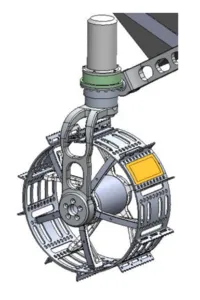
In the Rover Permitivity Sensor (RPS) project, we are developing a sensor that measures the electrical permitivity of the lunar regolith. RPS is to be integrated into the wheel of the Rashid-3 rover from MBRSC (UAE) and is expected to be send to the Moon in 2028. The sensor consists of two electrodes of different sizes which are mounted to one of the rover's wheels and connected via a slip ring to the sensor's front-end electronics inside the rover. The accommodation of the electrodes on the rover wheel allows RPS to map the regolith's water content in the lunar subsurface along the rover's track.
TUM is currently conducting a feasibility study that includes
- Development of the front-end electronics
- Integration of the electrodes on the rover wheel
- Life time, vacuum, thermal testing of the mechanical interface between wheel and rover body (slip ring)
- Regolith temperature measurement via IR sensors
The Parts of the Rover Permittivity Sensor
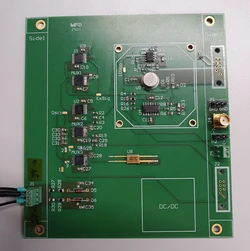
The front-end electronics is located inside the rover body. It generates a square-wave excitation signal with different frequencies and processes the measurement signal from the electrode.
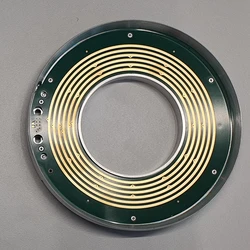
The slip ring provides a shielded connection between the front-end electronics in the rover and the electrodes on the rover wheel. It must not affect the reliability of the wheel due to increased friction or its complete blockage.
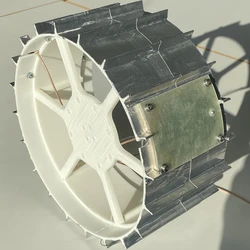
The electrode comes into contact with the undisturbed lunar regolith. Its dimensions define the maximum measurement depth. An integrated resistive temperature detector provides contextual data.
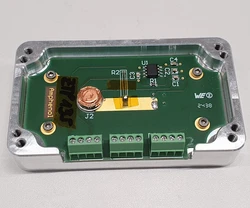
IR-Temperature Measurement Unit
A thermopile sensor sees the undisturbed regolith in front of the rover and gathers additional temperature information. Knowledge of the regolith temperature is essential for the correct evaluation and interpretation of the permittivity measurement.

Publications
Sesko, R., Laub, P., Sedlmair, F., Chauhan, S., Eckert, L., Gscheidle, C., and Reiss, P.: Experimental investigation of the soil interaction and wear of lunar rover wheel-based sensors, Europlanet Science Congress 2026, The Hague, The Netherlands, 7–11 Sep 2026, EPSC2026-816, doi.org/10.5194/epsc2026-816, 2026.
Šeško, R., Eckert, L., Gscheidle, C., Trautner, R., and Reiss, P.: A Dust-Tolerant Slip Ring for Lunar Rover Wheel-Mounted Sensors, 21st European Space Mechanisms and Tribology Symposium, Lausanne, Switzerland, 24–26 Sep 2025, 2025.
Gscheidle, C., Eckert, L., Sesko, R., Trautner, R., and Reiss, P.: Feasibility of a Rover-wheel-based Permittivity Sensor for Prospecting Lunar Water, EPSC-DPS Joint Meeting 2025, Helsinki, Finland, 7–12 Sep 2025, EPSC-DPS2025-922, doi.org/10.5194/epsc-dps2025-922, 2025.
Eckert, L., Gscheidle, C., Šeško, R., Trautner, R., and Reiss, P.: An Infrared Temperature Measurement Unit for the Rover Permittivity Sensor, EPSC-DPS Joint Meeting 2025, Helsinki, Finland, 7–12 Sep 2025, EPSC-DPS2025-661, doi.org/10.5194/epsc-dps2025-661, 2025.
L. Eckert, C. Gscheidle, R. Sesko, R.Trautner, P. Reiss.: A Rover Permittivity Sensor for In-Situ Lunar Water Ice Detection, European Lunar Symposium 2025, Münster, 22-27 June 2025. Available Online