
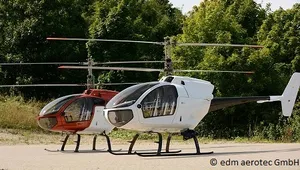
The project investigates the use of eco-efficient flax-carbon hybrids (FCH) as a sustainable alternative to CO₂-intensive materials such as carbon in aviation, particularly in helicopters. The goal is to implement FCH not only in secondary but also in primary structures to achieve greater CO₂ savings. This requires in-depth studies on fatigue resistance and the nonlinear behavior of the materials to increase industry acceptance.
Another focus is on developing robust, series-production-ready manufacturing processes. Current trial-and-error methods in composite manufacturing are considered inefficient. The increasing complexity introduced by hybrid materials requires precise material characterization and predictive models—particularly for long-term behavior under operating conditions. Special attention is given to local stiffness transitions caused by carbon patches.
The project follows the ‘P-approach,’ in which experimental data from realistic specimens are integrated into simulation models to accurately predict component behavior. This enables optimization of manufacturing strategies, conservation of resources, and reduction of production waste. The method will first be demonstrated on samples and substructures and finally validated on an actual primary helicopter structure.
