
WARR Space robotics
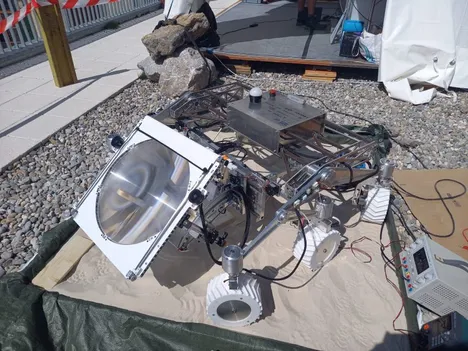
The WARR ist the biggest student group at TUM, working on ambitious projects around the theme of space.
The WARR rover is designed to be a mobile building machine. Thanks to the mounted solar sintering device, the rover can sinter regolith, a material that can be found everywhere on the lunar surface. This concept is called In-Situ-Resource Utilization (ISRU). Building materials don’t need to be brought from Earth, which allows a save on transportation costs. Thus, the work of WARR Space robotics contributes to a sustainable building procedure on the Moon.
The WARR is always looking for committed and energetic students of all disciplines who are willing to participate closely in the further development of the project. If you are looking for practical experience in a diverse and exciting working environment, write them!
WARR MOVE – DEDRA Sensor

In the course of the MOVE project, students are working on developing a satellite bus that can accommodate different types of payloads. Among the possible payloads is the DEDRA sensor, which will play a vital role in the MOVE-III mission. The MOVE project itself is being carried out by the WARR student group.
The Debris Density Retrieval and Analysis (DEDRA) sensor represents an innovative space instrument that has been developed to measure submillimeter space debris, micrometeoroids, and in general space dust. It is based on the principles of plasma ionization, which involves the impact of particles on an impact plate that leads to their partial ionization due to their high kinetic energy. The sensor is equipped with an entrance grid and two high-voltage electrodes that perform measurements on the particle cloud generated as a result of ionization. These charge curves characterize mass and velocity of the particles.
The DEDRA sensor is a unique project designed to contribute to sustainable research in space. It builds on the previous Munich and Mars Dust Counters and promises to be an important addition to the space debris monitoring infrastructure. The knowledge gained from this project will not only help us better understand the complex nature of space debris but will also play a key role in supporting efforts aimed at promoting the safe and sustainable use of space.
Unlike previous sensors, the DEDRA sensor features specially developed electronics that enable in-situ filtering of the data to avoid noise, a problem that has plagued previous instruments. The data collected by the sensor will primarily be gathered in Low Earth Orbit (LEO) and then fed into the European Space Agency's (ESA) MASTER and DRAMA space debris models for verification.

BEXUS - PHILEAS
PHILEAS (Project for High Altitude Identification for Lightweight Exogenic Airborne Specimen) investigates the propagation of microplastics in the higher atmosphere and is the first experiment of its kind. Microplastic particles can travel very long distances in our atmosphere and reach remote regions, where they significantly contribute to the global pollution of ecosystems. Despite this risk, little is known about how exactly these particles spread in the atmosphere, and it has never been measured how high they can rise. PHILEAS aims to investigate on this and thereby contribute to environmental protection.
The project is being developed by a small group of students from TUM and will be launched into the stratosphere in October 2026 aboard a stratospheric balloon as part of the REXUS/BEXUS programme of the German, Swedish, and European space agencies. There, using a vacuum pump, it will draw in ambient air and pass it through specialised membranes that filter out microplastic particles. These particles will then be brought back to Earth, allowing the concentration of microplastics in the stratosphere and the types present to be analysed. You can find more about the PHILEAS project on our Instagram account @phileas_warr and on our website.
Homepage
REXUS – GOOSE
Our project, GOOSE (Germanium Orbital Optical Semiconductor Experiment), focuses on improving semiconductor crystal growth in microgravity. Our goal is to develop a furnace module that will fly to the edge of space on a sounding rocket and process germanium using the floating zone method. This research has the potential to advance semiconductor manufacturing and unlock new opportunities for space-based technologies.
We are an enthusiastic, globally diverse, and interdisciplinary team of students from various universities in Munich. Our members include Bachelor's and Master's students collaborating on the REXUS/BEXUS program, which offers students the chance to carry out experiments in near space conditions. Want to be part of a collaborative team working on a one-of-a-kind space mission? This is your chance to contribute to cutting-edge aerospace research while expanding your skills in a supportive, innovative environment. Project GOOSE is always looking for new members! Join us on our journey as we push the boundaries of innovation and contribute to the future of space research!